Training Parameters
Hyperparameters
1. Learning Rate
- Definition: How fast the AI tries to learn from its mistakes. Think of it like adjusting your aim in darts: a big learning rate means making huge corrections, while a small one means making tiny, careful adjustments.
- How it is tuned: We start small. If the AI learns too slowly, we increase it. If it gets confused and makes erratic mistakes, we decrease it.
- Recommended value space: 0.0001-0.01
2. Batch Size
- Definition: The number of examples the model processes at the same time before updating its knowledge.
- How it is tuned: It depends on the available computer memory (VRAM).
- Recommended value space: 8-32.
3. Epochs
- Definition: How many times the AI reads through the entire set of examples. One epoch means the AI has seen every single training image exactly once.
- How it is tuned: We set a number based on how long the model needs to adequately learn the patterns in the data, ensuring it learns general patterns without simply memorizing the training set.
- Recommended value space: 10-100.
Note on Parameter Selection: These values are provided as ranges rather than fixed inputs because the platform employs a Random Search optimization algorithm. During execution, the system evaluates various random combinations within these boundaries to efficiently identify the best-performing configuration for your data.
Augmentations
These techniques slightly change the original images to artificially create new data, helping the model generalize better.
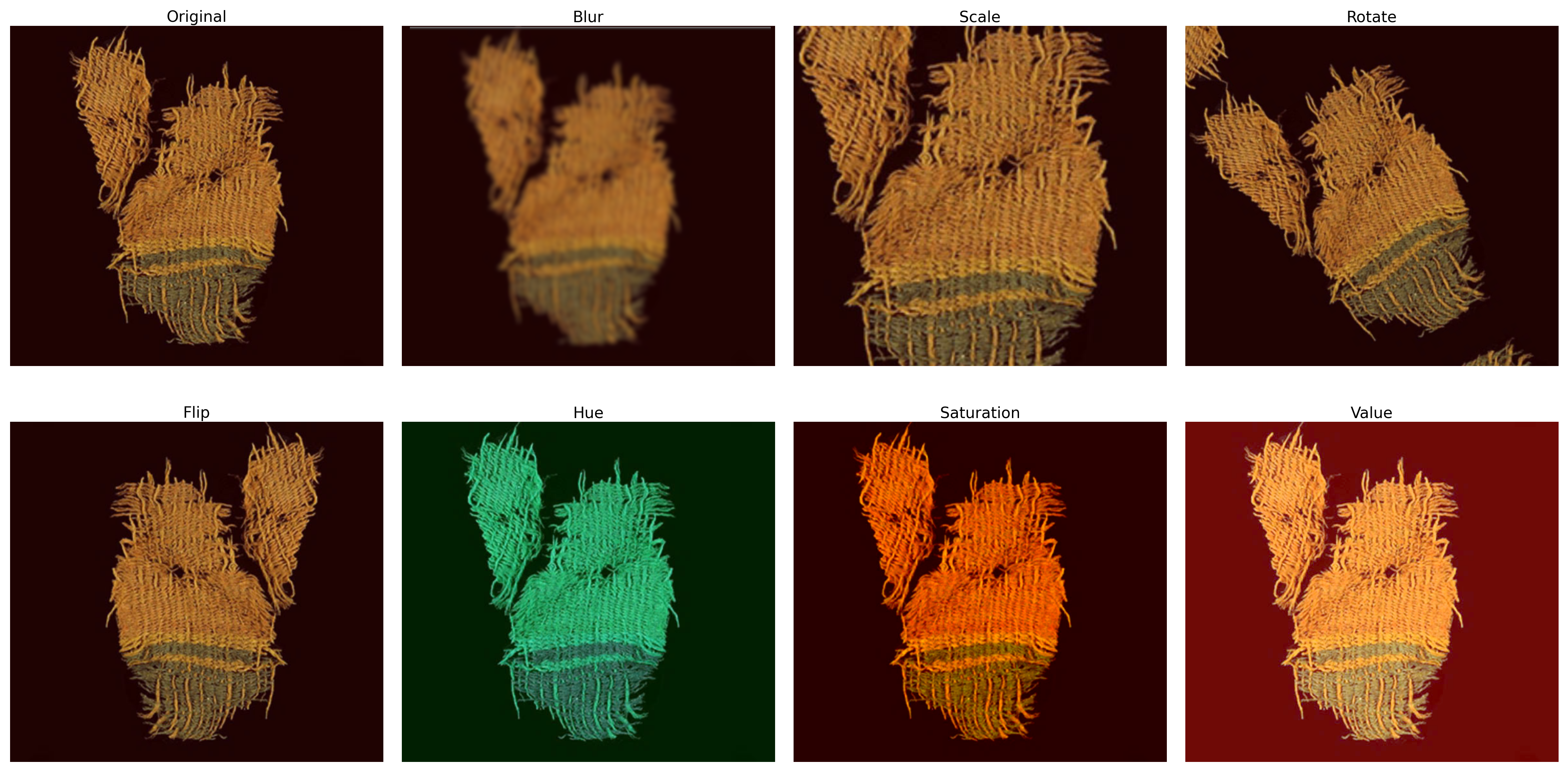
- Blur: Makes the image less sharp.
- Scale: Zooms in or out.
- Rotate: Turns the image by random degrees.
- Flip: Mirrors the image horizontally or vertically.
- Hue: Slightly changes the color spectrum.
- Saturation: Makes the colors more vibrant or more washed out.
- Value: Changes the brightness or darkness of the image.